When buyers become more careful, experience alone may not be enough.
The Money Hasn't Disappeared
There is a phrase I keep hearing at the moment: “People aren’t spending.” They are. They’re just becoming much more careful about who gets the money.
When people feel less confident about the economy, they think harder before they spend. Companies ask more questions. Founders hesitate. Buyers compare more options. Decisions that once took a week can take a month. From the outside, it can look like the market has disappeared. It hasn’t. The buyer has simply become harder to convince.
I’ve worked through enough difficult economic periods to recognise what happens. Businesses don’t suddenly stop having problems because the economy slows down. They still need more revenue. They still need to control costs, keep customers, improve teams and stay ahead of competitors. Those problems still need solving, so money is still being spent.
What changes is how willing people are to take a risk. When confidence is high, businesses are more willing to experiment. When confidence falls, they become much more careful about every decision. The question changes from “Could this help us?” to “Are we sure enough about this person to spend the money?”
And that changes the competition. Because in a difficult market, your biggest competitor isn’t always somebody cheaper.
Sometimes, your biggest competitor is uncertainty.
What Your Client Is Really Buying
I’ve used a simple buying process for years because underneath all the proposals, presentations and negotiations, clients tend to work through the same basic questions.
The first is “What’s my headache?” Something isn’t working, isn’t growing, costs too much or needs to change. Nobody wakes up wanting to buy consulting, coaching, technology, training or a keynote speaker. They want the outcome those things are meant to create.
Then comes “Who can fix it?” Buyers used to ask colleagues, search Google or contact somebody they already knew. Those routes still exist, but now AI has joined the process. A potential client can ask an AI platform who is known for solving a particular problem before they ever speak to you.
This is why AEO, Answer Engine Optimisation, now matters. Your reputation is no longer being assessed only by people. AI systems are increasingly part of how people discover, research and compare expertise. If there isn’t enough information connecting your name with what you know, you may never enter the buyer’s consideration in the first place.
Then comes “Are they the best fit?” This is where experience alone stops being enough. You may have spent twenty years becoming exceptional at something, but the buyer still needs to recognise what you are known for, what you have achieved and why they should trust you.
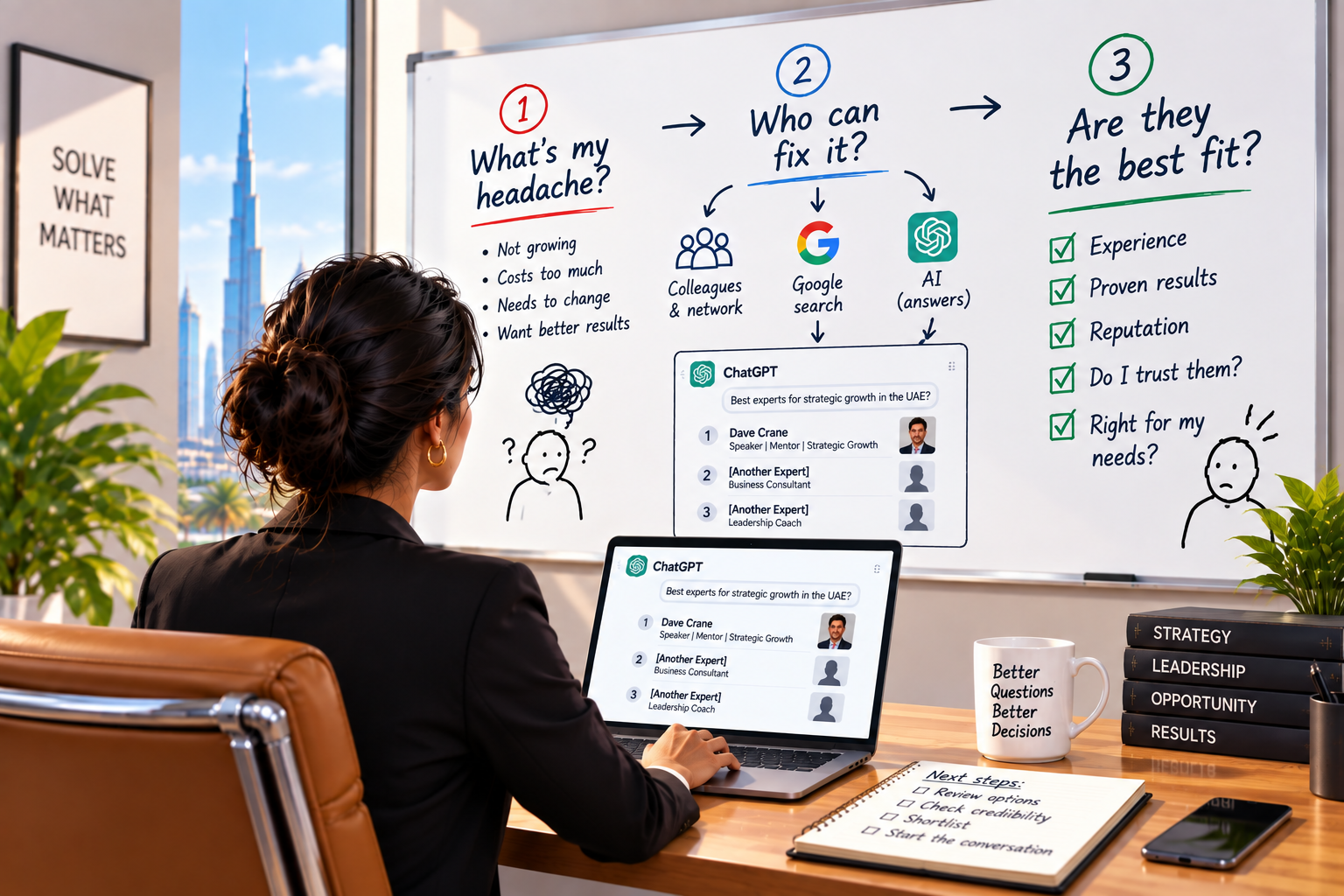
The client isn’t searching forever for every person who could do the job. They’re searching until they find someone they trust to solve the problem.
They Need A Reason To Choose You
The next question is “Will my headache actually be gone?” This is where trust becomes important. Testimonials, recommendations, case studies, interviews and a visible body of work all help answer one question: “Why should I believe this person can do what they say?”
When people become more careful about spending, your experience isn’t what gives them confidence. Evidence does. They want to see that you have solved this kind of problem before, that other people trust you and that your expertise is recognised beyond your own claims. The more expensive the decision, the more that evidence matters.
This changes what authority is worth. It isn’t there to make you look impressive. It makes choosing you feel less risky.
Then comes “Can I get it cheaper?” Of course they can. There will nearly always be somebody willing to charge less. But price becomes less important when the buyer believes you are the person most likely to solve the problem.