Both get results. Only one lasts.
Most people believe strong leaders lead with pressure. When results slow down or standards slip, the instinct is to tighten control. Raise expectations. Make it clear who is in charge.
And in the short term, that might work.
People respond. They adjust. They become sharper while you are watching.
But that response is fragile.
It depends on your presence. On your tone. On the weight you carry into the room.
Remove that pressure, and the energy often fades.
That difference is easy to miss at first.
Over time, the cost is quiet, but it is expensive.
People do what is instructed, but rarely more than that. They follow the brief. They meet the target. They complete the task.
But they stop stretching.
They stop thinking ahead. They stop questioning weak ideas. They stop raising difficult truths.
The work gets done.
It just does not get better.
You remain central to progress. Decisions circle back to you. Problems move upward instead of being solved where they begin.
From the outside, nothing looks broken.
Inside, scale becomes slower.
What began as strength slowly turns to dependency.
And what depends on you cannot grow beyond you.
This is where the question becomes personal.
What kind of leader are you building?
- One who stays at the centre of every decision?
- Or one whose influence spreads without force?
Most leaders do not choose this consciously.
They reinforce it in small moments.
The alternative is not softer. It is smarter.
Psychologist Scott Barry Kaufman calls it the Light Triad.
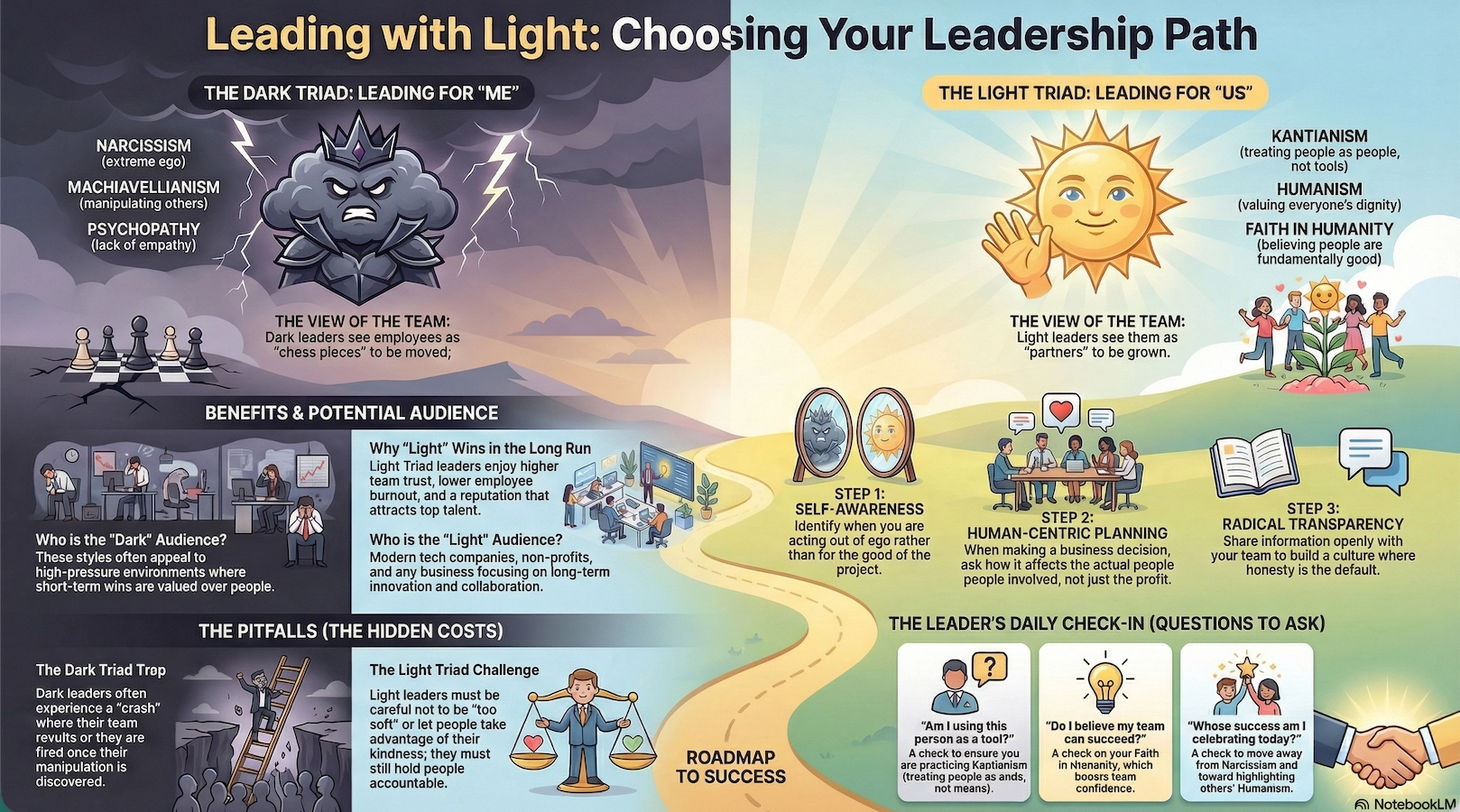
It rests on three simple ideas:
- Treat people as people not tools.
- Believe people matter.
- Assume most people are capable.
In practice, this changes how a team operates.
- Responsibility spreads.
- Standards hold without constant reminders.
- Strong people grow instead of shrinking.
- Difficult conversations happen earlier not after damage is done.
Empowerment is not a slogan. It is what allows scale without constant supervision.
The same principle applies beyond your team.
Clients lean in when they feel respected, not managed.
Partners invest more when they feel trusted, not pressured.
Constant pressure may get a quick result.
Respect earns long-term loyalty.
That is what scales.
Some of the most effective leaders I have worked with are not loud.
They do not compete for attention.
They do not rush to dominate a discussion.
They listen.
They set standards clearly.
They correct early.
They do not create theatre to prove authority.
When they speak, the room adjusts.
Not because pressure was applied.
Because their authority is understood.
They do not rely on constant oversight.
They do not tighten control to stay relevant.
Their direction holds, even when they are not present.
That is not softness.
It is disciplined leadership.
"Influence is what remains when you step away."
- The Thought Leader's Playbook
This is where intention turns into structure:
- Before your next major decision, explain why it matters before saying what needs to be done.
- Credit someone publicly for a win this week.
Most people stop there. That is fine. If you want to go deeper, here is the next step.