Have you noticed how stability doesn't protect you
the way it used to?
📌 In This Issue:
- Why stability no longer protects smart, capable people
- What "real security" actually looks like when industries shift
- How to start building leverage before pressure forces you to
Choose Carefully: 3 houses, 3 Futures
We grew up believing stability was real.
Get a job.
Work hard.
Stay loyal.
And life would take care of you.
That belief didn't come from nowhere.
It was taught.
Repeated.
Rewarded.
For a long time, it even worked.
But the world that belief was built for no longer exists.
Think back to The Three Little Pigs.
One built his house from straw.
One from sticks.
One from bricks.
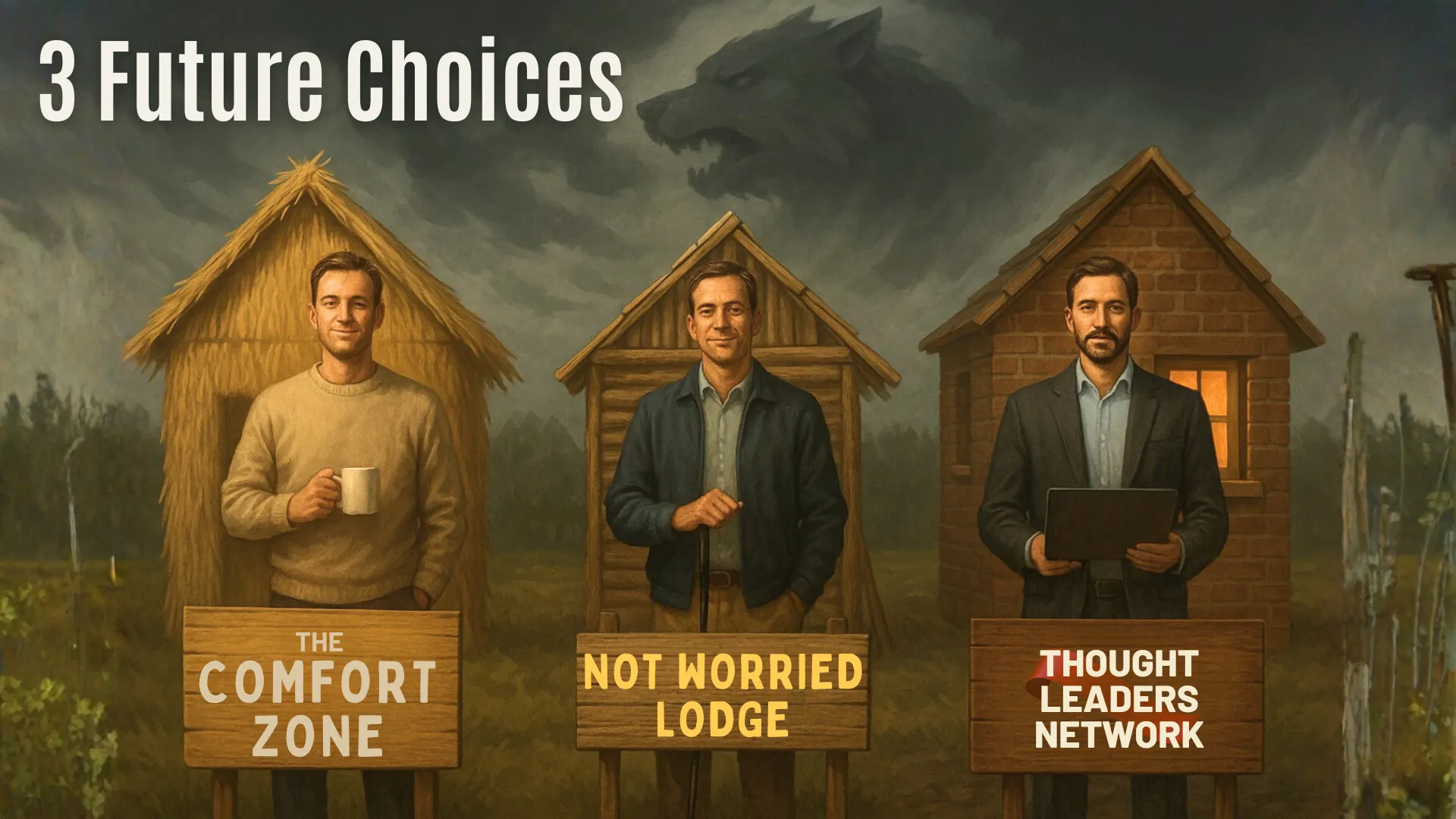
All three houses looked fine.
Until the wolf came.
That story was never really about pigs.
It was about preparation.
About what you build before the pressure arrives.
They didn't do anything wrong.
They followed the rules they were given.
But they built on foundations that no longer hold.
And most people don't realise that... until the wind is already blowing.
The danger isn't change.
The danger is believing... the old definition of safety still applies.
Because when pressure arrives, it's not talent that protects you.
It's what you built before you needed it.
This is yours.
AI.
Automation.
Layoffs.
A shrinking middle class.
Running costs rising faster than wages.
Decision makers acting in their own interests.
Industries transforming overnight.
A global economy that doesn't care how loyal or talented you are.
You can't negotiate with a wolf.
You can't ask it for more time.
You can't hope it's in a good mood today.
You either built your house... or you didn't.
And most people don't realise they're still living in straw and sticks... until the wind hits their door.
This newsletter is your reminder:
your future depends on what you build today,
not what you hope will happen tomorrow.
How Sensible Choices Quietly Become Fragile
Most people didn't choose straw or sticks on purpose.
They chose what made sense.
Straw is fast.
It's efficient.
It rewards loyalty and consistency.
That's the person who built a solid career, earned a title, stayed dependable, and assumed that reliability would be valued long term.
For a long time, it was.
Until that person quietly becomes too expensive to keep.
Not because they failed.
But because the numbers changed.
Sticks feel like progress.
A little more effort.
A little more visibility.
Enough to feel responsible.
That's the person who keeps a LinkedIn profile up to date, posts occasionally, stays informed, and assumes that being competent and present will be enough when decisions are made.
Often, it has been.
None of this is wrong.
None of it is lazy.
None of it was a bad decision at the time.
It simply wasn't designed to compound.
The risk isn't what people did.
It's what they didn't realise they needed to build alongside it.
What Bricks Actually Are
Bricks aren't louder.
They're slower.
They don't rely on permission.
They don't disappear when budgets tighten.
They don't depend on who's in charge this quarter.
When I talk about "real security" today, this is what I mean:
- People know who you are and what you're good at, even when you're not in the room
- Your opinion carries weight because it's trusted, not because it's loud
- Your name reduces risk for decision-makers, instead of adding to it
- Opportunities come to you, instead of you constantly chasing them
- Your income isn't tied to one employer, one platform, or one gatekeeper
- You have relationships that open doors, not just contacts saved in a phone
- When decisions are made under pressure, you're part of the conversation
That's what turns you from a cost into leverage.
Not because you work harder.
But because decisions feel safer with you involved.
This is where many people get it wrong.
They think bricks mean more content.
More posting.
More noise.
It doesn't.
Bricks are about being known for something specific.
About being associated with clarity, judgement, and outcomes.
They compound quietly.
And that's exactly why they hold when pressure arrives.
Because when things shift, decision makers don't ask:
"Who's been here the longest?"
They ask:
"Who do we trust?"
"Who makes this easier?"
"Who reduces risk?"
Those questions don't reward straw or bricks.
They reward bricks.
Why the Jack of All Trades Usually Wins
Look back at my timeline and you'll see it clearly.
Every storm forced a change.
Every wave demanded a new version of me.
I started as a journalist and a radio geek in the UK.
Then I became a DJ because it was the cheapest passport to the world.
That opened doors into nightlife, hospitality and entertainment, which I used to leverage my way into radio overseas.
Radio gave me fame, momentum and opportunity.
But radio was never going to last forever.
I saw the wind shift early.
So I moved sideways into events, long before presenters who stayed behind realised the industry was shrinking.
Then I reinvented again.

- DJ -> stage hypnotist
- Stage hypnotist -> hypnotherapist
- Hypnotherapist -> speaker
- Speaker -> trainer
- Trainer -> Wellness event host
- Wellness -> NLP
- NLP -> corporate consulting
- Corporate -> global MC
- Global MC -> thought leader
- Thought Leader -> Mentor
At this point, some people look at that list and think:
Jack of all trades, master of none.
But, my friend, the original phrase actually goes further:
"A jack of all trades is a master of none,
but oftentimes better than a master of one."
The meaning gets lost because most people only hear the first half.
It was never meant to be an insult.
It describes someone who builds range instead of dependency.
Someone who can adapt when conditions change.
Someone whose value increases across situations, not just in one narrow lane.
In other words, someone who isn't exposed when one path disappears.
What looks like variety on the surface is actually resilience underneath.
Each skill is a brick.
Each transition adds depth, not distraction.
That's how real security is built over time.
Every new identity came from the same 3 instincts:
I saw change coming early.
I acted before the crash.
And I followed the opportunities others were too slow to see.
Even the pandemic didn't break the pattern.
When the world froze, events died and microphones went cold, I didn't wait to be rescued.
I reinvented myself again, this time as a branding expert, because my early celebrity years in Dubai taught me exactly how visibility works.
It wasn't luck.
It was pattern recognition.
The ability to read the wave before it hits.
And that's why I created the Industry Icon Roadmap.
It's a blueprint built from decades of surviving storms that wiped out entire industries.
If you're reading this, you're not at the end of your story.
Do I cling to the old life?
Or do I reinvent and rise?
And that decision - not talent, not timing, not luck - is what shapes the next chapter of your future.
5 Ways to Build Real Security Now
- Own your voice
Decide one topic you want to be trusted for and speak about it publicly every week in your own words.
If people can't recognise your point of view, they can't trust it. - Build a brand that survives impact
Make sure people can explain what you're good at without mentioning your job title or employer.
If your title disappeared tomorrow, your value should still be clear.