

At a recent HR leadership session, I stood in front of a room full of senior professionals and asked one deceptively simple question:
"What's the biggest communication challenge in your team right now?"
I expected a mix of responses. Maybe some would mention time. Others might point to nerves or a lack of leadership buy-in.
But what I wasn't quite prepared for was just how many leaned into the same answer.
🟣 32% said: Weak personal branding
🟠 26% said: All the above - imposter syndrome, fear of public speaking, difficulty pitching, no time to train
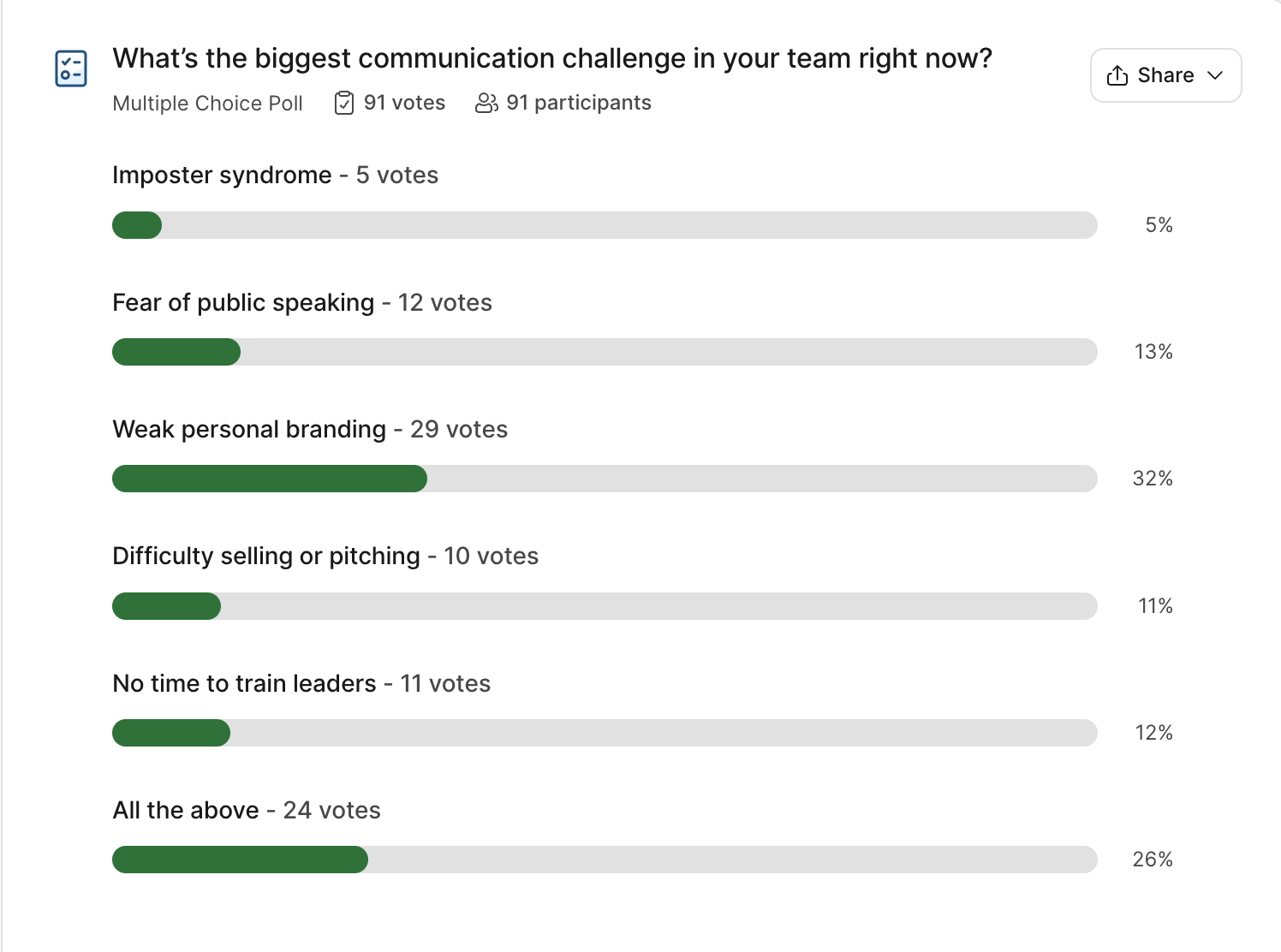
That's more than half the room, openly admitting there's visibility problem.
Not in the company's external markting - but inside it's own walls.
Now that's worth pausing for.
The question:
Why are so many people still hiding in plain sight?
The answer is:
They don't know.
I've worked with C-suite excutives, future leaders and technicle experts for over two decades. Across industries, countries and cultures, one truth keeps surfacing:
👉🏾 The people who do the work, who know the business inside out, and who genuinely care about the outcomes tend to be quieter about it.
Especially in HR cirlces.
They're rarely the ones who speak up.
They tend to be supporters and nurturers.
👉🏾 Often, they're the ones quietly watching louder voices take the floor.
Why?
Imposter syndrome and cultural stigma.
There's a myth that still lives in many professional environments.
A whisper in the back of the room that says:
"You're not supposed to talk about yourself."
"If you're good, they'll notice."
"Don't look like you're showing off."
"We value humility here."
And while humility is an admirable trait, misunderstoof humility becomes invisibility.
Wrong era.
Social and new media have destroyed the monopoly of conventonal TV, radio and magazines.
We've entered the citizen's broadcasting age.
You have to share your story in fun, challenging and fascinating ways to make people ask for more.
92% of professionals say they suffer from imposter syndrome - they feel they've been caught, exposed and even labelled as frauds.
So they stay quiet in an age where grabbing attention is everything.
Wrong move.
Wrong direction.
Let's clear something up:
Personal branding is not about bragging.
It's a not about filters, followers, or selling yourself online.
It's certainly not about trying to become an "influencer".
What it IS, is this:
- The ability to express:
Who you are.
What you believe.
The value you bring.
In a way that feels authentic and useful to others. - The confidence to speak clearly:
Whether it's in a boardroom.
A presentation.
A team huddle.
Or a LinkedIn post. - The clarity to represent:
Your role.
Your company
Your mission.
All without second-guessing yourself.
And in 2025/6, with AI rewriting the rules of communication...
this skillset is no longer optional.
Your people don't need to become thought leaders for the world.
They need to be recognised voices inside your organisation.
Because your personal brand is what people say about you when you leave the room
In my book, The Thought Leaders Playbook, Chapter 2, opens with this:
"Most of the people who are overlooked in business aren't the weakest links - they're the quietest. And that silence costs them more than they know."
(Chapter 2 - The Invisible Expert)
Think about the missed opportunities here:
- Ideas that never get shared
- Projects that never get picked up
- Talented individuals who stay in the background forever
Not because they want to... but because they're afrad of what it might cost to step forward.
Would your team admit they're unsure how to speak in meetings - or that deep down, they're just scared to be seen saying the wrong thing?
That hesitation is costing more than you think.
The truth is, charisma can be taught.
So can clarity, confidence and cultural impact.
I've lost count of the number of brilliant professional who've told me:
"I don't want to look like I'm promoting myself..."
"It feels natural to talk about what I do..."
"I don't want people to think I'm full of myself."
These aren't excuses.
They're warning signs that you're losing talent to silence.
When your people learn how to show up without showing off, everything improves...
✅ Team morale
✅ Stakeholder trust
✅ Cross-functional visibility
✅ Retention of future leaders
✅ Organisational culture that reflects what it says it believes
And best of all?
It sticks.
It becomes part of your culture.
A company that grows thought leaders.
If this resonates, I'd love to hear from you.
Ask yourself:
🗣 What's the biggest communication challenge in your team right now?
📩 Hit reply and tell me one thing that holds your people back.
💬 Or drop a comment below, I read every response.
No spotlight. No hard sell.
Just a conversation worth having.
Because if no one knows what your people stand for...
You and your company are invisible in a business world that holds your values above your pricing.
Let's talk.
Warm regards,
Dave Crane
Author, The Thought Leaders Playbook
💡 BONUS resource: Want to lead from the front in 2025?
Here are 15 ways to skyrocket your personal brand - practival, proven and built for professionals who don't want fluff.




Responses