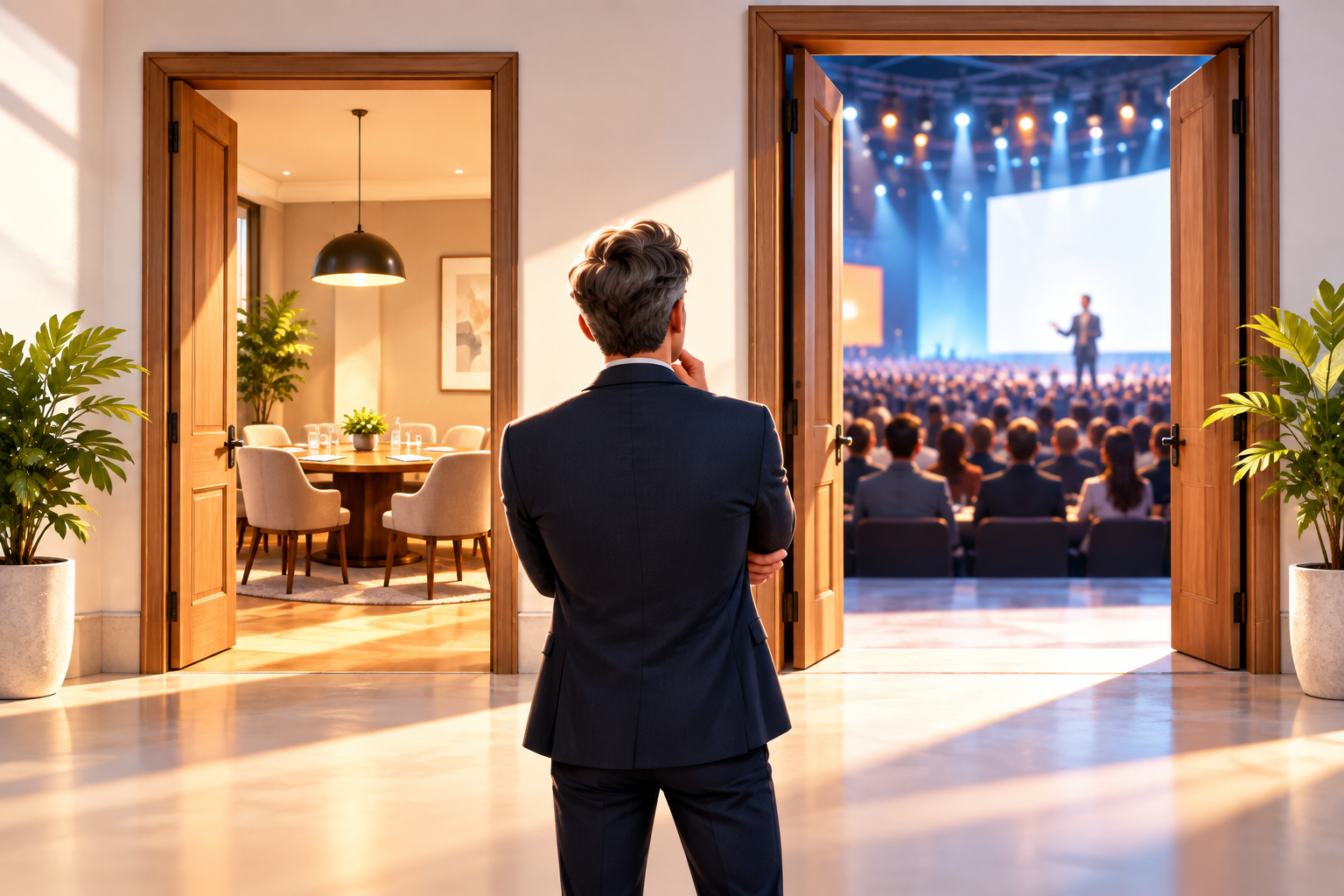
The size of the audience changes more than the
number of people in the room.
The Room Is Talking Too
I’ve spent much of my working life in rooms full of people. Sometimes it has been one person sitting opposite me. Sometimes 15 people around a table, 500 people at a conference, or tens of thousands at the Dubai Rugby Sevens, which I hosted for 20 years.
For years, I thought the obvious difference was scale. A conversation with one person feels completely different from speaking to 500 people, and put 50,000 people in front of you and it changes again. But after enough time in those rooms, I started noticing that it wasn’t simply the number of people that changed. The relationship between the speaker and the audience changed too.
With one person, most of the communication is happening between the two of you. You notice the expression on their face, the pause before they answer and the moment their attention shifts. Around a small table, you can still see most of that because you are still communicating with individuals.
Then the room gets bigger, and something else begins to happen. Someone laughs and other people laugh with them. A few people start applauding and suddenly the room joins in. One section becomes restless and you can almost feel it travel. Sometimes hundreds of people become completely silent at the same moment.
The audience is no longer only responding to the person at the front. They are responding to each other. And once I noticed that, I realised the size of the room doesn’t simply change how many people are listening.
It changes how the room itself communicates.
The Wi-Fi Code of The Room
I recently came across an article about why crowded events can leave us feeling drained. One explanation was that our brains developed for much smaller social groups, not rooms filled with hundreds or thousands of people. That theory is debated, but the observation behind it made sense to me.

Walk into a crowded room and you are processing far more than you realise. Faces, voices, movement, body language and noise are all competing for attention. At the same time, you are making constant social decisions. Who do I know? Who should I speak to? Where do I belong? Is everyone else enjoying this?
I’ve noticed that once a room grows beyond the intimacy of a small group, something else starts happening. I call it the Wi-Fi code of the room. People are no longer connecting only with the person speaking. They are also picking up signals from everyone around them.
You see it when laughter spreads across a room, when a few people begin applauding and others join them, or when hundreds of people suddenly become silent. We respond to what is happening around us, and those reactions begin to shape our own.
That is why 500 people laughing together is not simply 500 individual reactions happening at the same time. People hear the laughter around them, see other people reacting and feel the mood of the room changing. The audience becomes part of the experience.
The emotion in the room doesn’t just reflect what is happening. It can make it bigger.
Bigger Isn't Always Bigger
For years, bigger was usually seen as better. A bigger conference. A bigger audience. More followers. More views. More people watching. If you could fill a bigger room, it looked like you were doing something right.
I understand that. I’ve spoken at conferences with hundreds of people and hosted the Dubai Rugby Sevens in front of tens of thousands. There is nothing quite like the energy of a huge crowd. When that many people react together, the audience becomes part of the event.
But recently, I’ve noticed something happening in the other direction. Some of the best conversations I’m having are in much smaller rooms. Private dinners. Roundtables. Breakfasts. Closed groups. Rooms where nobody really cares how many people are there because the value comes from who is there and what happens between them.