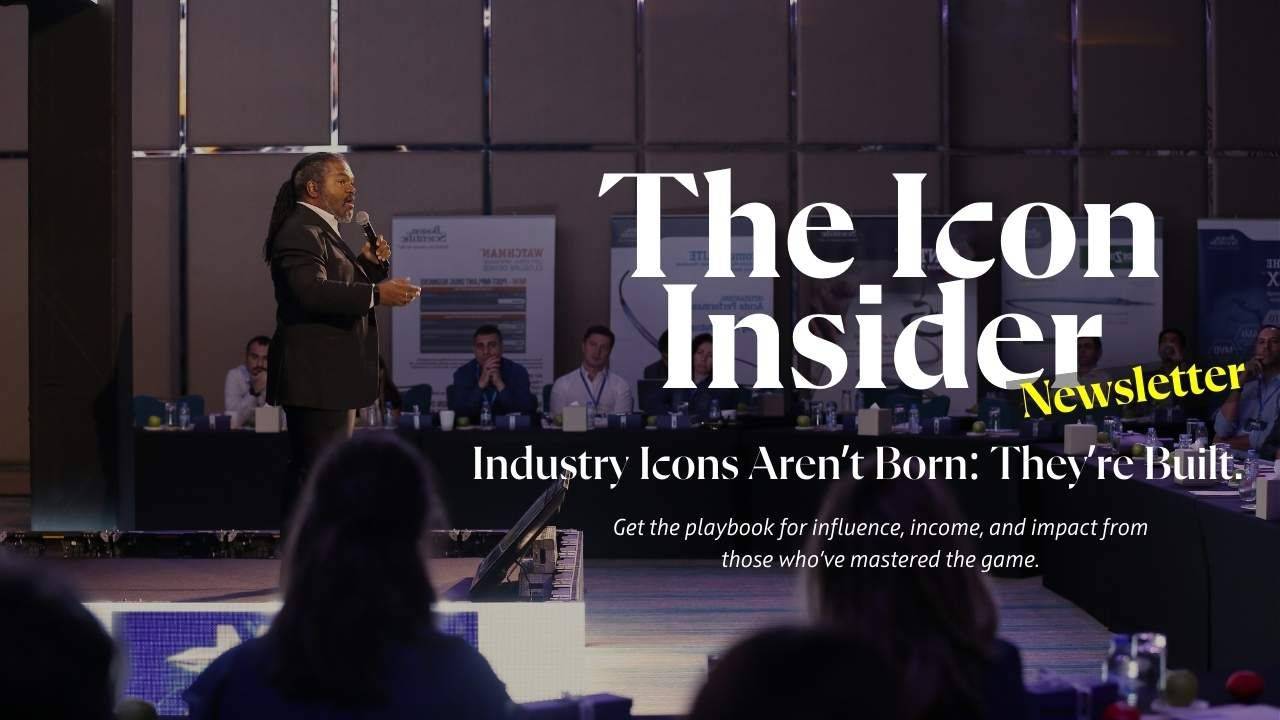
If trust is eroding online, this is where credibility is now decided.
📌 In This Issue:
- Why comfort is now the biggest risk for experienced professionals
- What actually makes you credible in an AI-driven world
- How to turn years of experience into authority and leverage
The Danger of Being Comfortable
Most people don't think they're at risk.
They're busy.
They're competent.
They're doing what's always worked.
They've found a rhythm and stick to it.
Same clients.
Same platforms.
Same way of working.
And because things are moving, because work is coming in, it feels safe.
That's comfort.
And comfort quietly turns into complacency.
We've already seen how dangerous that can be.
When the pandemic hit, entire industries stopped almost overnight.
People physically couldn't meet.
Rooms closed.
Audiences vanished.
Movement stopped.
Most didn't plan for it.
Most thought they had time.
Now, I see many are back in that same pattern again.
People feeling settled.
They're "doing fine".
Soon, we will head into another shift.

It's AI.
Content can be AI-generated.
Voices can be cloned.
Experiences can be packaged to look real.
And the ones most exposed?
They're not beginners.
They're the comfortable ones.
The Cost of Staying Comfortable
The danger isn't that everything suddenly stops.
It's that things slowly stop choosing you.
If you stay comfortable while AI accelerates, the shift doesn't announce itself.
You're still working.
Still visible.
Still "doing fine".
But behind the scenes, the rules change.
Comparisons become instant.
Alternatives multiply.
And differentiation gets harder.
So, if you don't adapt.
If you don't understand how perception is changing.
If you don't AI-proof how you're positioned...

You become lost in the crowd.
Not because you're bad.
But because you're doing the same thing as everyone else.
And when you're competing with everyone doing the same thing as you,
what actually makes you stand out?
That's the real cost.
Fees get squeezed.
Budgets go elsewhere.
You're negotiated down instead of sought out.
Opportunities don't disappear.
They just move past you, quietly.
Panels happen without you.
Rooms form without you.
Decisions get made elsewhere.
And by the time you realise,
your leverage has already gone.
Why Being Seen Is No Longer Enough
Welcome to 2026.
For a long time, the goal was visibility.
If people could find you,
follow you,
see your work online,
you stay relevant.
That made sense when visibility was rare.
But visibility isn't rare anymore.
Everyone is visible.
Everyone is posting.
Everyone looks competent.
So the question has changed.
It's no longer,
"Can people see you?"
It's
"Do they trust you?"
And trust doesn't come from what you publish.
It comes from how people experience you.
How you think out loud.
How you respond under pressure.
How you handle questions you didn't prepare for.
That's the shift.
2026 isn't about being more visible.
It's about being more believable.
Because when AI can generate convincing experiences,
it's human judgement, experience, taste, context, and credibility that still stand out.
And I can already hear the next question.
So how do you actually do that?
Start here:
What's the thing you've been doing brilliantly for the last 20 or 30 years?
Not loudly.
Not necessarily on LinkedIn.
Possibly without ever calling yourself an expert.
Guess what? You are an expert.
It doesn't have to be your job title.
It could be a spin-off from your role.
It could even be a serious hobby.
If you've spent decades gardening every weekend, producing a beautiful rose garden, you don't have enthusiasm.
You have insight.
Patterns.
Stories.
Proof.
And that's what people pay for.
Here's the key most people miss.
Document it.
Take photos.
Record videos.
Share insights.
Do it now.
Because when you finally say,
"I can help with that."
the best response isn't persuasion.
It's recognition.
"I know. That's why I contacted you."
Turning Experience into Authority
Four years ago, Carl Wamsley came to me and said something I hear a lot.
"Dave, I'm doing well.
But I know I'm capable of more."
Carl wasn't inexperienced.
Far from it.
He had decades in construction, operations and leadership.
So we didn't reinvent Carl.
We didn't manufacture a brand.
We went back.
We looked at his history.
His values.
His credibility.
The things he'd already earned, but hadn't fully claimed.
Then we positioned it properly.
Fast forward to today.
Carl has studied at Harvard Business School. A lifelong goal.
He's helped deliver one of the world's most luxurious hotel development in Dubai.
He's mentored over 150 construction professionals globally.
He's stepped into a COO role aligned with his values and growth mindset.
He's judging major industry awards and supporting professional bodies across the region.
None of that came from chasing trends.
None of it came from pretending to be someone else.
It came from recognising that his past wasn't just experience.
It was leverage.
Once Carl owned that, opportunities stopped needing persuasion.
They started finding him.
That's what happens when expertise stops hiding and starts showing up.
The Six-Step Business Reframe
When something stops working in your business, most people either panic or pivot blindly.
Both are expensive.
Before you change everything, reframe what's actually happening.
This six-step process comes from NLP, but this version is about reinventing your business, not fixing your mindset.
Save this. It could protect your income.
Step 1: Call the Problem Properly.
- What exactly is broken?
- Not "business is slow."
- "This offer no longer sells."
- "This skill is being commoditised."
- "This audience has moved on."
Precision creates options.
Step 2: Remember the Original Job
What was this product, service or role meant to do?
Most things don't fail.
They outlive their original context.